

Good morning, afternoon, and evening,
This week, a few more signals appeared among the noise.
Let’s talk money first. On March 11, the European Commission approved €260 million in additional state aid from Belgium to support the Kairos@C CCS project, led by Air Liquide and BASF at the Antwerp industrial cluster.
Over 15 years, the project aims to prevent around 20 million tonnes of GHG. That’s 1.33 million tonnes per year, roughly equivalent to taking about 290,000 gasoline-powered cars off the road every year.
For advocates of CCS, this is a great milestone, arguing that Europe’s heavy industry (chemicals, steel, cement, etc.) has limited decarbonization pathways without CCS.
Critics see something else: the fact that a project already awarded €365 million still required another €260 million to stay afloat, reinforces a reality: CCS remains structurally dependent on public subsidy and is not yet commercially viable on its own.
Kairos (Ancient Greek: καιρός) means the exact or critical moment. Whether CCS represents Europe’s right moment - or simply expensive timing - remains an open question for the public and the emerging industry to see in the next 15 years.
Moving to a real industry - the German automotive sector.
Case pleaded on The European Correspondent: for decades, Germany’s economy ran on a simple formula: cheap energy, strong engineering, and export dominance. And it worked super well.
At their peak, companies like Volkswagen, Mercedes-Benz, and BMW generated roughly 30% of their global sales in China. But that has changed. Chinese manufacturers now produce nearly 10 times more electric vehicles than Germany, and some models can add 400 kilometres of range in under five minutes of charging.
Ripple effect? Between 2024 and 2025, Germany’s automotive industry eliminated 51,500 jobs, about 7% of its workforce.
At this pace of competition (plus the complete supply chain in China), high energy prices, and the EU’s 2035 phase-out of new combustion engine sales, we are not convinced that the magic pill of lobbying would work as well for German manufacturers anymore. After all, to industries, 2035 is tomorrow.
That being said, Chancellor Merz might have new ideas from his recent state visit to China.
Speaking of China, it keeps trading.
In the first two months of 2026, China’s foreign trade reached $1.12 trillion - up 18.3% year-on-year. Exports rose 19.2%, imports 17.1%, with mechanical and electrical goods - the backbone of industrial supply chains - climbing 24.3%.
But the most interesting thing is: the geography of trade has shifted.
China’s commerce with Southeast Asia grew 20.3%, while trade with the European Union rose 19.9%, and flows with Belt and Road economies increased 20%.The United States remains China’s largest individual trading partner at $560 billion, yet bilateral trade fell nearly 19% as tariffs reshaped supply chains. Trade with ASEAN economies continues accelerating - Vietnam alone up 13.7%, alongside strong growth in Indonesia, Thailand and India.
Speaking of South East Asia, the region’s demand for liquefied natural gas (LNG) is rising rapidly. So does the price: climbing to a six-month high of $13.7 per MMBtu. This is far below the $68.80 peak in 2022, but still enough to create panics. Analysts warn: trying to decarbonise an economy while relying on a commodity that can spike overnight “doesn’t make sense.”
We would have to ask: wait, since when has LNG been considered a “decarbonised” energy solution?
Anyhow, the recent event at Hormuz proved the supply chain point: 75% of oil and 59% of LNG passing through the Strait of Hormuz flow to four Asian economies: China, India, Japan and South Korea.
Guess these countries will turn to Australia for LNG soon? No straits between them - Australia was the #1 trade partner of LNG to Singapore, Malaysia, and the Philippines in 2024.
Speaking of trading, this week, the Tocco team launched tocco.agency.
The idea is simple: we leverage the network we’ve built across Asia-Pacific, Europe, and North America, to identify the right suppliers, validate them, and ship what you need to your door.
If that sounds useful to your case, come take a look.
Speaking of “usefulness”, single-use cutlery can become a debate at the dinner table.
Depending on what your camp is, one thing is for sure: the global crackdown is happening, and we trace these in our latest report, “Fork Off: 2030 Guide to Plastic-Free Cutlery”.
We talk about sourcing strategies for large-scale procurement and emerging materials in this space (yes, we talk about edible cutlery too).
Enjoy your weekend. Stay sharp - and keep building.
Anh
On behalf of the Tocco team
Deep Read of the Week: The Hormuz Shock
If you think Hormuz is an oil story - it’s not. When a chokepoint comes under stress, it ripples into shipping, insurance, plastics, working capital, lead times, and executive decision-making. According to Leon Ge, Tocco’s Founder, this is a new industrial tax.
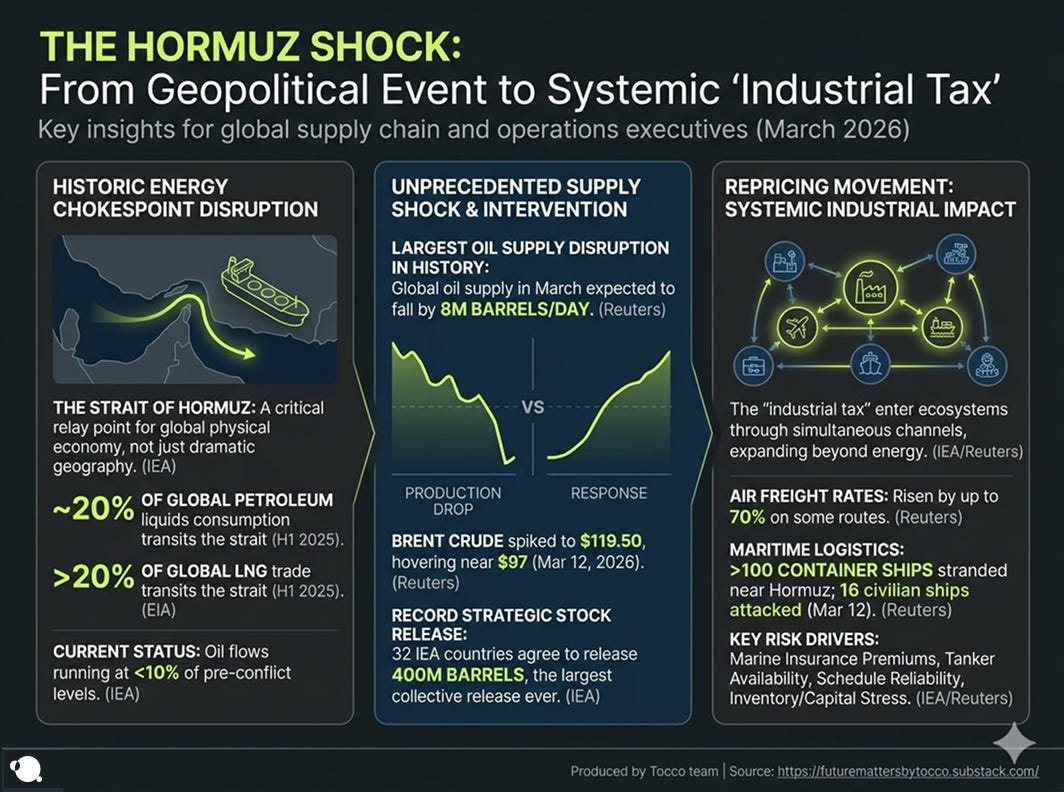
If your world includes sourcing, logistics, manufacturing, procurement, or cross-border operations, this is the one deep read we would recommend this week.
Further reading ⋅ 13.03.2026
(Australia 🇦🇺) Australia invests $53 million in critical minerals refining. Through the Critical Metals for Critical Industries (CMCI) research centre, Australia is accelerating domestic processing of lithium, cobalt and vanadium - a reminder that control over mineral refining may become as strategic as mining itself. This is in the same line as the EU Circular Economy Act out last month.
(UK 🇬🇧) New Research on Cost-effective and Sustainable Microalgae Cultivation is out. A low-cost artificially integrated LED photobioreactor ensuring high-quality algal biomass production from industrial CO2 flue gas in a high latitude country.
(Global 🌏) The 2026 Packaging Alternative Materials Matrix. We mapped 20+ packaging materials across performance and end-of-life clarity. This serves as a reference for EU-compliant strategies.
(Global 🌏) Alternative Cutlery 2026. A quick visual overview of plastic replacements in cutlery, comparing compliance status, production maturity, and performance (wood, bamboo, PLA etc.)
(Europe 🇪🇺) Extended Producer Responsibility (EPR) in the EU. If you have 5 min only - this is how EPR works and what it means for brands, manufacturers and importers.
Private invitation: FutureMade China
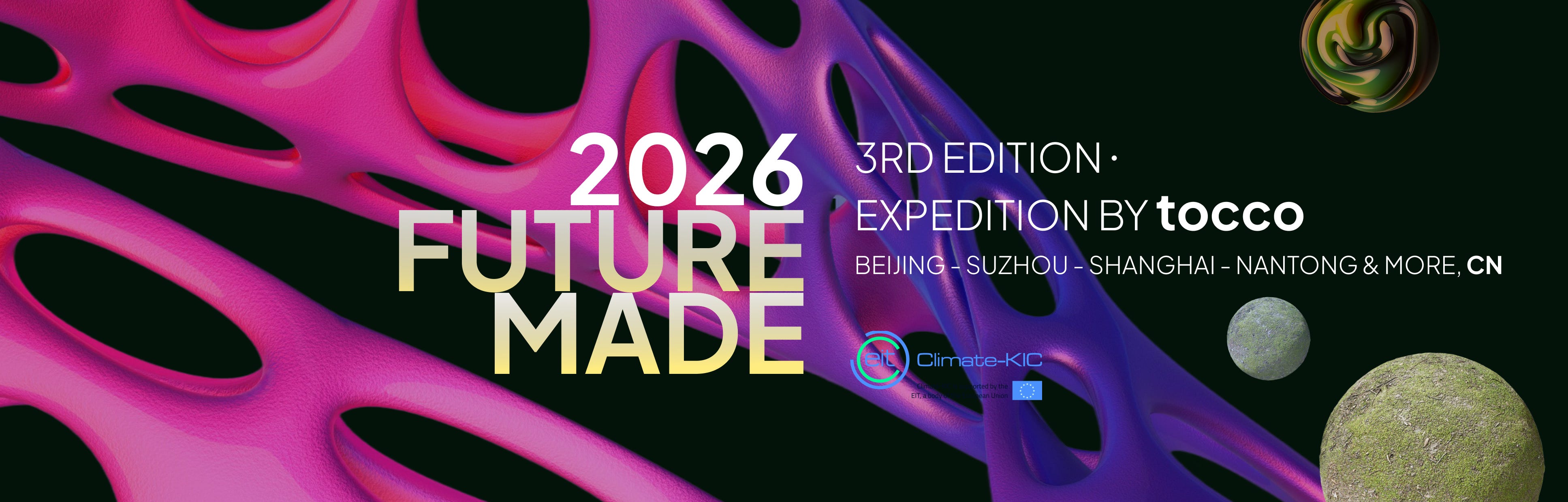
A small group of founders, investors, and senior operators will join us in 2026 for a closed-door immersion into China’s industrial frontier - from advanced manufacturing and robotics to AI, biomanufacturing, and the ecosystems shaping the next decade. If you want to see the China that most executives never get access to, apply for an invitation here.