

Five stories that matter this week:
As predicted last week, higher gas prices linked to Iran conflicts are hurting European heavy industry fast. One of Britain’s last major chemical plants says it will shut the site if energy prices stay this high for the next three months and will import from China or the US. The owner says his UK factory has gone from being his lowest-cost aniline plant in the world to his most expensive - in only four years.
This is certainly not a stand-alone case. EU industrial energy costs are now running at double US levels - and the trend doesn’t seem to revert anytime soon. The question now for Europe is whether SMEs and Mid-caps can keep producing at this cost. As our friends at New Wave Biotech (UK) put it, “most companies still make million-euro process decisions with half the picture”.
We’ll cover more on this story in the next couple of weeks - in case you’d love to share your real story, drop me a line at anh(at)tocco.earth.Across the globe, China just approved its 15th Five-Year Plan (2026-2030) on March 12. For a country whose manufacturing output has been the world’s largest for 16 consecutive years, the focus now is on “high-quality development”, which includes innovation, green transition, public well-being and security. According to Janice Hu, chairperson of UBS Securities, China’s innovations across AI, high-end manufacturing, semiconductors, and new energy are reshaping how the world sees its assets. We would also add biotech and bioengineering to this stack.
Cooperation is definitely in the plan. Earlier this year, China & South Korea expanded climate and tech cooperation, and China’s exports and imports with ASEAN surpassed 1 trillion USD in 2025. The latter happened as a result of rather massive trade agreements such as ACFTA 3.0 (upgrade to the ASEAN-China Free Trade Area) and RCEP - Regional Comprehensive Economic Partnership (world’s largest free trade bloc (including 15 Asia-Pacific members, 10 ASEAN nations plus China, Japan, South Korea, Australia, and New Zealand).
Leon, Tocco Founder & CEO, has been leading FutureMade, high-end innovation and industrial expeditions to China’s backstage. 2026 is the third year running. If you have a real (potential) agenda for China & APAC, pre-seats to be claimed directly with him leon(at)tocco.earth.Back to Europe. As of January 1, CBAM - EU’s Carbon Border Adjustment Mechanism - now carries direct financial consequences for importers of iron, steel, aluminum, cement, fertilisers, electricity, and hydrogen.
The logic is this: EU producers already pay a carbon price through the ETS. CBAM extends that price to imports so everyone competes on the same footing. In the first week of 2026 alone, EU customs processed over 1.65 million tonnes of CBAM-covered goods - 98% of them iron and steel. In case you wonder where CBAM sits among all other manufacturing-related regulations, check out this matrix for simple mental notes. (axis X= Circularity, axis Y= Non-toxicity).Out to space now - literally. On March 16, NVIDIA announced its latest accelerated computing platforms, targeting orbital data centres, geospatial intelligence, and autonomous spacecraft operations. Indeed, NVIDIA is not the only one in the game. Blue Origin filed plans for a constellation of up to 51,600 satellites for orbital data centres on March 20. That’s a bit timid on Jeff Bezos’s side, because SpaceX had requested permission for up to 1 million in early January. Google’s Project Suncatcher will launch prototypes in 2027.
Currently, a 1 GW orbital data centre might cost $42.4 billion - nearly 3x its ground equivalent. But the logic of moving AI centers to space is precisely a cost story: while it’s expensive to launch servers into orbit, the operating costs on Earth are skyrocketing (electricity bills, multi-year waits to connect to the power grid, water to cool down the chips). In space, once the initial hardware is launched, the energy from the sun is free and 24/7, while cooling is handled by passive radiators. Basically, companies can bypass Earth’s infrastructure constraints completely.
But all stories of physical matters are a material story first and foremost:Space-rated panels using rare earth elements are durable but prohibitively expensive. Silicon panels (used by Starlink and Kuiper) are cheap, but space radiation degrades them fast - limiting satellite lifespans to around five years.
Cosmic radiation causes bit-flip errors that corrupt data. Protection options - shielding, rad-hardened components, redundant error checks - all add weight and cost.
We’ll be following the story of critical minerals in the next couple of weeks. The ones dug out of Earth, to be precise. We’re not yet mining them out of any asteroid belts.
Back on Earth. This week, we cover Industrial Robotics with an Executive Outlook on 2030. We talk about dark factories, heavy-duty and industrial-grade robots, vision-language-action AI models, robotics-as-a-service, among other things. Check out this report if this is your space, or simply if you’re curious about what manufacturing would definitely look like by 2030.
Enjoy your weekend. Stay sharp - and keep building.
Anh
On behalf of the Tocco team
Deep Read of the Week: Germany and China EV
Germany built the old automotive playbook. China is now reviving it.
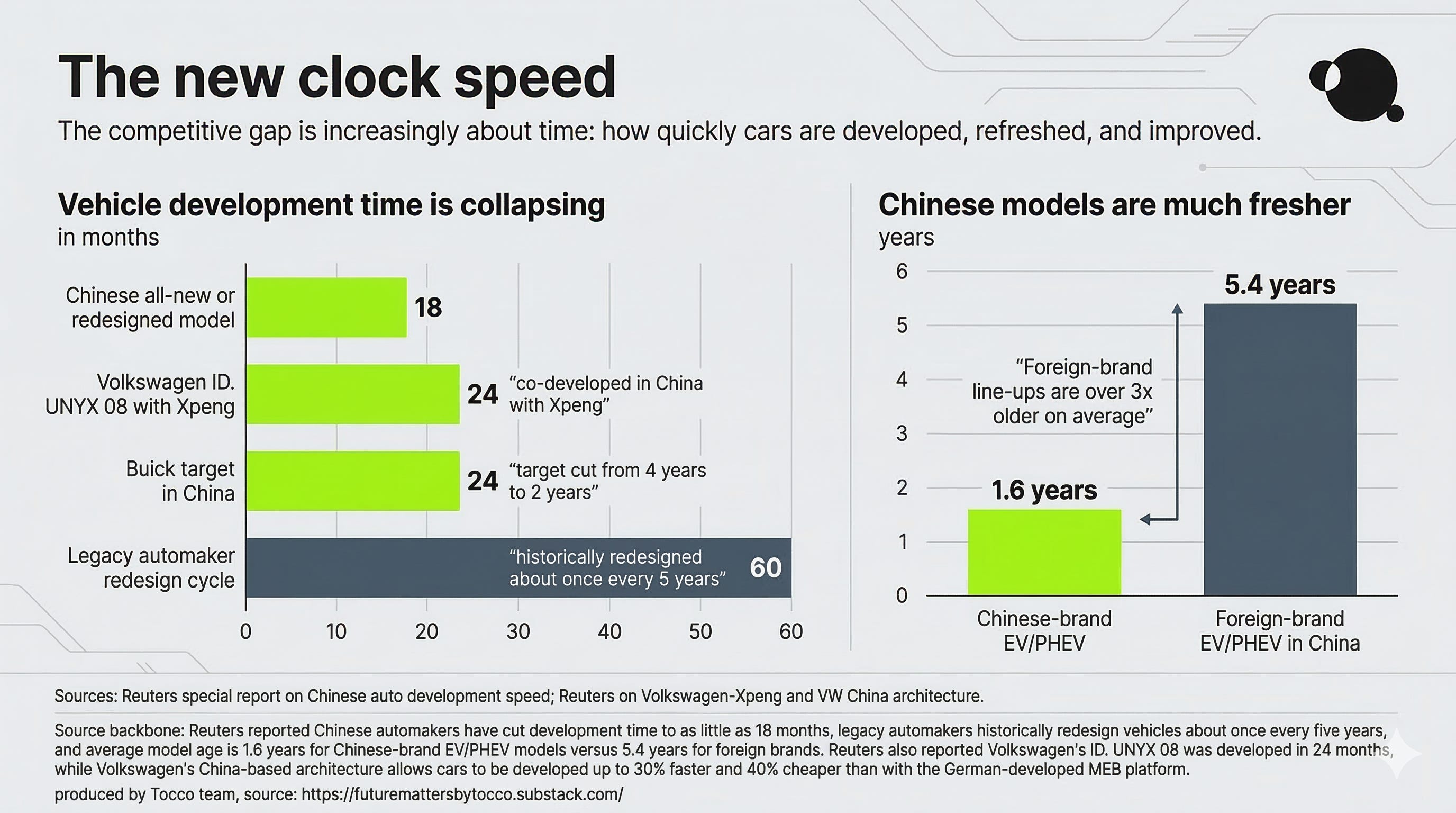
This is beyond cars. Through the story of cars, Leon took a deep dive into how the Chinese, APAC, and Western industrial ecosystems actually work over the last 5 years, with predictions for the next 5. The piece is what he distilled after having visited across 100+ factories, companies, and industrial parks over the past 18 months.
If you want to speak with Leon about China, industries, geopolitics or AI - feel free to ping him at leon(at)tocco.earth
Further Readings · Material & Manufacturing News · 03.2026
(Global 🌏) PFAS Packaging Regulations: What the Phase-Out Actually Means for Your Specs? For packaging - especially food-contact and fibre-based formats - regulators are shifting from substance-by-substance controls to “PFAS as a class.”
(Global 🌏) Toccographic: 2026 Global Plastic Cutlery Ban Timeline: Track the worldwide phase-out of single-use plastic cutlery - key regulatory dates and upcoming mandates across the EU, US, and APAC.
(EU 🇪🇺) EU Inc: A Single European Company Status The European Commission proposed a unified company status across all 27 member states - 48-hour registration, no capital requirement, digitalized procedures, etc. This is making headlines this week in Europe, which might give you the wrong impression that it is implemented. EU Inc. is still a proposal.
(Germany 🇩🇪) Level Nine Raises €4M to Turn Biomass Into Green Chemicals. Berlin-based Level Nine is building an AI-driven catalyst platform that converts biomass and waste into drop-in alternatives to fossil-based chemical feedstocks, with lower energy requirements and compatibility with existing infrastructure. The seed round will fund a planned kilotonne-scale demonstration plant.
(Research 🔬) Sustainably Graphitizing Biomass Into Advanced Carbon Materials: New research explores converting agricultural waste and organic biomass into high-performance graphitic carbon for batteries, energy storage, and environmental technologies - a potential alternative to mined graphite and fossil-based carbon materials.
Private invitation: FutureMade China
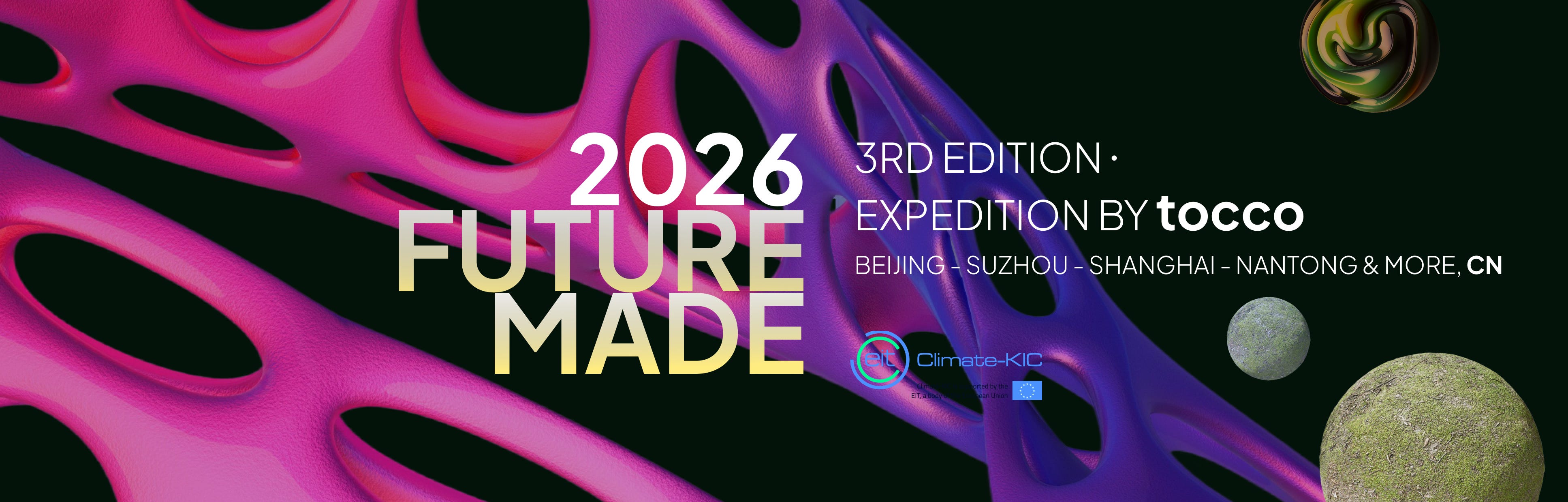
A small group of founders, investors, and senior operators will join us in 2026 for a closed-door immersion into China’s industrial frontier - from advanced manufacturing and robotics to AI, biomanufacturing, and the ecosystems shaping the next decade. If you want to see the China that most executives never get access to, apply for an invitation here.