


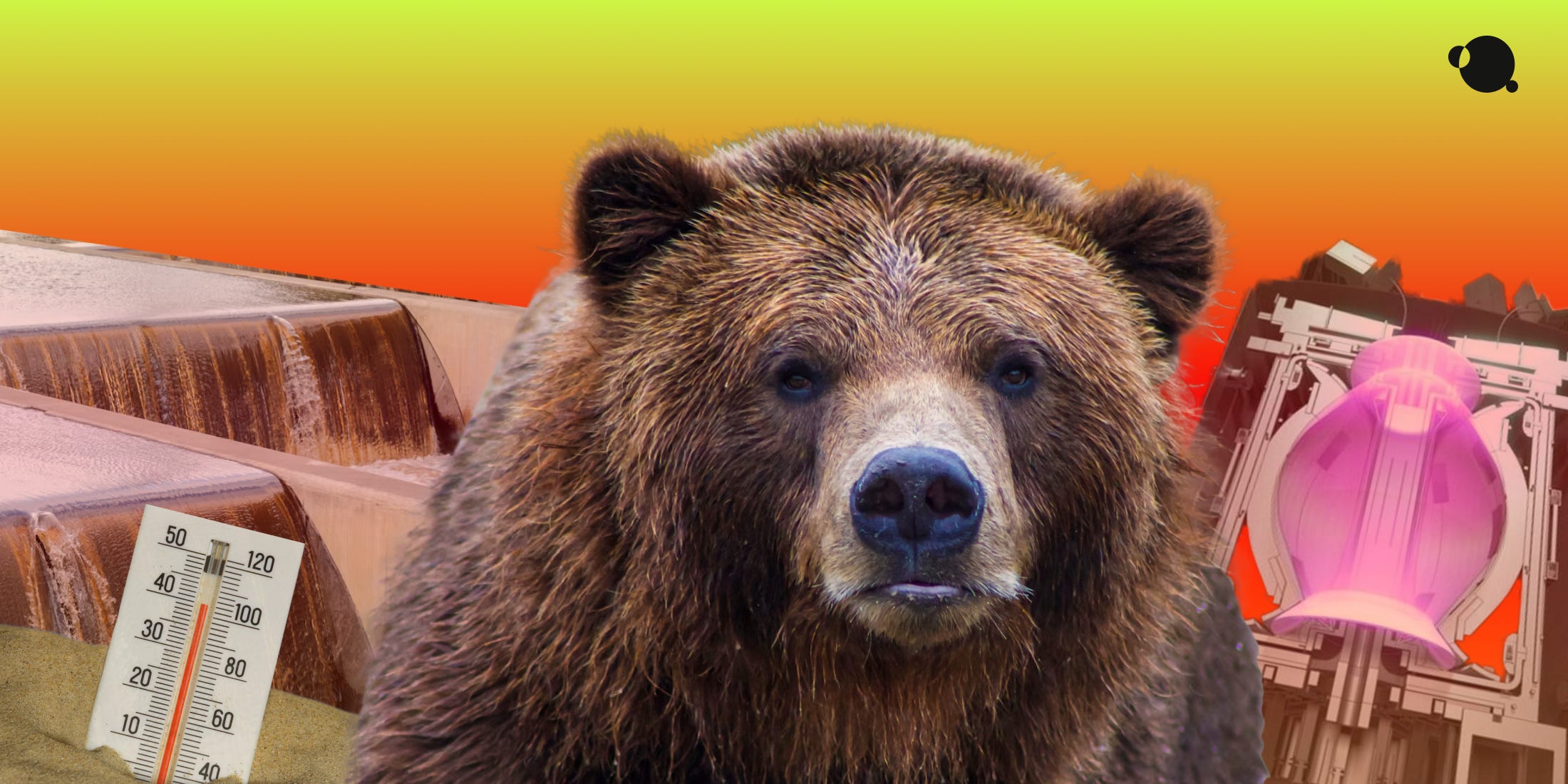
Five stories that matter this week:
Paris Fashion Week Men’s ran through a historic heatwave from June 24th to 28th, 2026, revealing a lot about luxury fashion as a whole. Louis Vuitton’s models emerged from a giant artificial wave in wetsuits made of neoprene and coats of cashmere and fur. Saint Laurent ran models through fog clouds in leather briefs and choker scarves. Timing is impeccable.
According to experts, the luxury fashion world operates on the assumption that affluent consumers live in climate-controlled microclimates year-round, making a wool coat in June a desired purchase. However, Europe is a continent built to retain heat and still largely considers air conditioning wasteful or unecological amid a heat wave that has killed 1,500 so far.
Still on Europe, the UK fusion sector is entering what several industry leaders described as the “pre-deployment phase” as they plan a £2.5 billion investment in fusion over 5 years, a record-breaking figure for the nation.
The UK is also seeing fusion’s commercial role differently. Compact fusion systems - onsite small-scale nuclear fusion reactors designed to generate 10 to 20 MW of power - are now being evaluated for sectors requiring continuous 24/7 power: data centres, maritime operations, and water treatment. The UK’s decision to regulate fusion under the Environment Agency and Health and Safety Executive and treat fusion as comparable to established chemical plants rather than fission also decouples them from nuclear site licenses and removes significant regulatory barriers for investors and operators.
Speaking of infrastructure, China’s Yarlung Tsangpo project in Tibet, which broke ground last July, has an estimated 60 GW of installed capacity and projected annual output of 300,000 gigawatt-hours - roughly three times as much electricity as the Three Gorges Dam, the world’s biggest hydropower project.
Pumped storage is an important note here, as pumped hydro systems operate as closed-loop water batteries, storing and releasing electricity on demand without disrupting natural river flows. China has over 217.5 GW of pumped storage capacity under construction and an installed base of over 69 GW, a massive difference from Japan in the second spot (at 21GW). For context: India has made plans for 100 GW of pumped storage by 2035, while the United States has plans to double its current installed capacity of 19 GW.
Still on East Asia, Suzhou-based autonomous driving company Momenta opened investor orders for its Hong Kong IPO this week, aiming to raise HK$5.9 billion ($752 million). Backed by General Motors and Tencent, the company would be valued at nearly $9 billion at the offering price - comparable to Uber’s $8.1 billion valuation when it first went public.
The capital going into autonomous driving platforms confirms that the sector has moved into commercialisation for mass-produced vehicles and robotaxi networks. For industrial operators in semiconductors, this accelerates demand for sensor arrays, edge-computing hardware, and specialised automotive chips. Dive deeper into navigating the current EV landscape with our report here.
Speaking of key industries, we published two deep dives this week on sectors where the August 2026 deadlines are now weeks away. Bio-based adhesives are growing at roughly twice the rate of the conventional adhesives market, reaching $6.8 billion in 2026 with a forecast of $15.26 billion by 2035. You can read the full analysis of this market here.
Separately, the moulded pulp market has reached $6.7 billion, already equivalent to roughly half the size of the EPS packaging market it is replacing, and growing at nearly twice the rate. The cellulose foam market is growing at 18.5% annually, nearly three times the rate of conventional packaging foam. For a full analysis of these markets, it is over here.
Further Readings · Material & Manufacturing News · 06.2026
(Vietnam 🇻🇳) Nasdaq-listed AMC Robotics signed a lease for a 6,150 sqm facility in Bac Ninh, committing $3.5 million to produce its “NovaArm” robotic arm for warehouse sorting and industrial automation. Production targets the second half of 2026. Vietnam’s manufacturing base continues expanding beyond consumer electronics into advanced robotics.
(United States 🇺🇸) A $1.7 million “ozone nanobubbler” system has been permanently installed at the Lincoln Memorial Reflecting Pool to combat algae blooms. The technology injects 500 million microscopic ozone bubbles per teaspoon of water, with Ohio State and NOAA studies showing 90th-percentile effectiveness in open waterways. Long-term success depends on the National Park Service repairing decades-old underground distribution pipes.
(United States 🇺🇸) An unnamed tech firm is proposing an 800-acre, $1 billion data center campus in Solon Township, Michigan, negotiated through a shell company under an NDA. Some said it could be Microsoft, but the possibility has been ruled out. The township previously enacted a six-month moratorium on data center proposals in February 2026, highlighting growing animosity between hyperscale infrastructure expansion and local municipalities.
(Brazil 🇧🇷) Elea and AXIA Energia Announce Amazon’s First AI Data Center: Elea Data Centers, in partnership with renewable energy provider AXIA Energia, is developing “BEL1,” the first AI-neutral data center in the Brazilian Amazon powered 100% by renewable energy. Scheduled to begin operations in the second quarter of 2027, BEL1 will serve as a resilient network alternative to Fortaleza (Brazil’s primary submarine cable gateway), utilizing the “Connected North” infoways program to reduce digital inequality and establish a new strategic connectivity hub in the North.