

Most people outside China will never read a five-year plan. I think that is a mistake.
Whether you like China, source from China, compete with China, regulate against China, or simply live in a world increasingly shaped by Chinese industrial capacity, a five-year plan is the coordination document mapping where the state wants capital, engineering, infrastructure, and corporate behaviour to keep compounding over time.
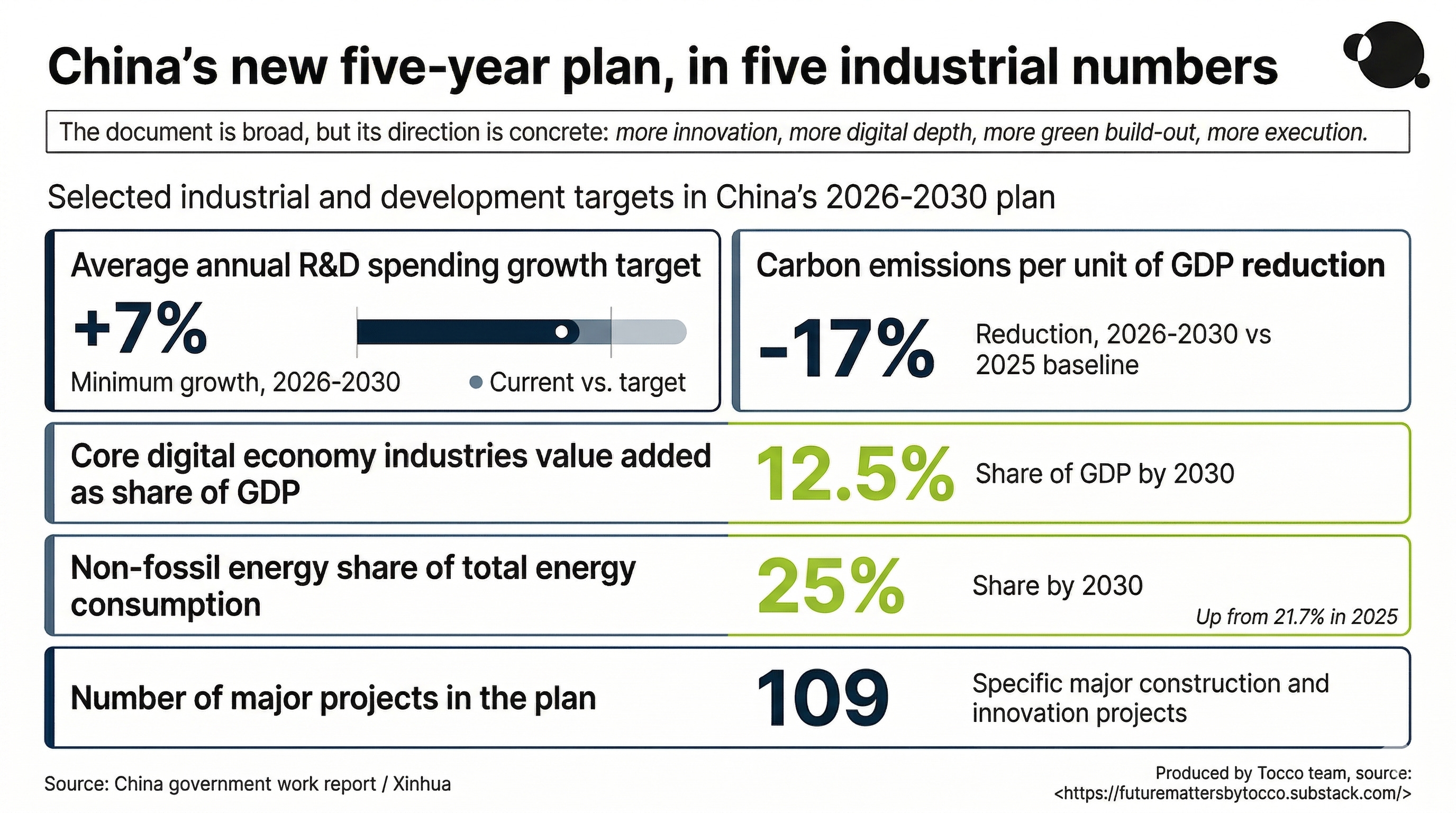
The plan calls for:
at least 7% average annual growth in R&D spending
a 17% reduction in carbon emissions per unit of GDP by 2030
raising the value-added share of core digital-economy industries to 12.5% of GDP
executing 109 major projects across six areas.
Reuters also reported that the blueprint is centred on lifting consumption, driving technological innovation, and scaling up advanced manufacturing. (State Council of China)
The Strategy: Thinking in Systems, Not Sectors
The first thing to understand is that China is treating manufacturing as the core of the modern industrial system. The real economy is not being treated as an afterthought to finance, apps, or consumption. It remains the spine.
The second thing is that the plan is not all about prestige technologies. Western coverage often reduces China’s industrial strategy to semiconductors or AI. But the less-covered but important story is that Beijing is trying to turn separate strengths into a denser industrial stack: AI, robotics, advanced manufacturing, power systems, logistics, semiconductors, digital infrastructure, electrification, and green industrial upgrading. That is the whole picture.
And this is where many Western readers might still underestimate China, as they still think in terms of sectors, while China is increasingly thinking in terms of systems.
The third thing is the new blueprint mentioning AI more than 50 times and included a sweeping “AI+” action plan - pushing AI and robotics into a wide range of sectors, from manufacturing and logistics to healthcare and education. The goal is to go beyond building good models and using AI to raise productivity across the physical economy.
That logic is already visible below the national level.
System Density allows both Internal Resilience and External Dependence
In Guangdong, China’s largest provincial economy and one of the most important manufacturing hubs in the world, officials said AI-driven industrial upgrading would sit at the centre of economic growth over the next five years. The province will deepen “AI plus” applications, expand computing infrastructure, and direct state capital toward advanced manufacturing sectors, including AI and drones. Shenzhen alone said strategic emerging industries already accounted for 43% of its GDP in 2025.
Jiangsu is moving in the same direction. China’s second-largest provincial economy and one of its most important manufacturing and export bases has more than 1,500 AI companies, ranks second nationally in computing capacity, has 66 large AI models and 283 registered algorithms, and is already applying AI across local manufacturing. One city, Yangzhou, said it had built 186 smart production lines in sectors including automotive components and environmental equipment. Jiangsu is also launching about 50 pilot AI applications in transport and logistics.
This is what I mean by system density.
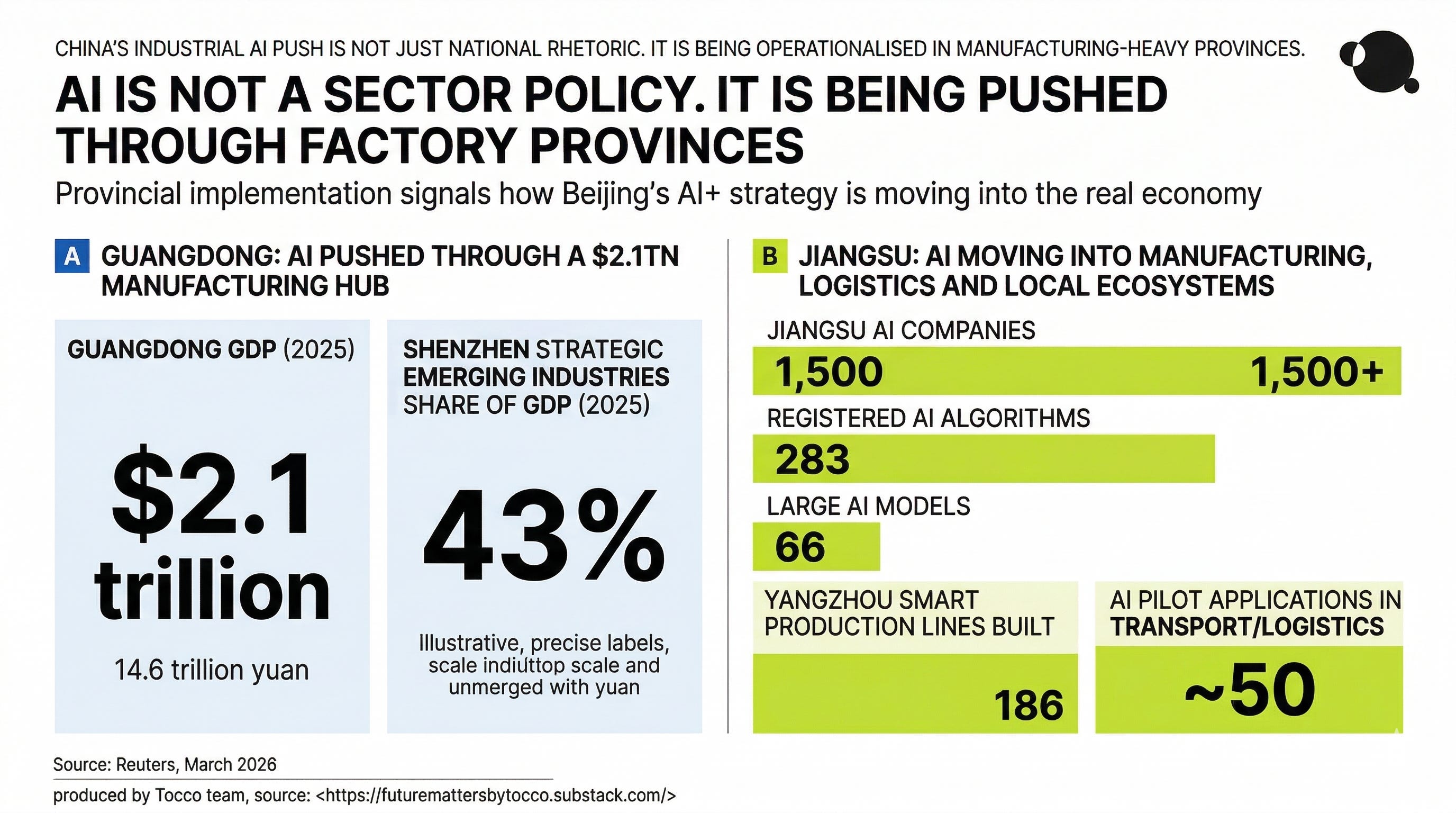
China is not backing a few national champions and hoping the rest will follow. It is pushing adoption through provinces, cities, sectors, and infrastructure layers at the same time. That does not eliminate friction or waste, but it does make the build-out harder to ignore.
Another illustration can be found in semiconductors.
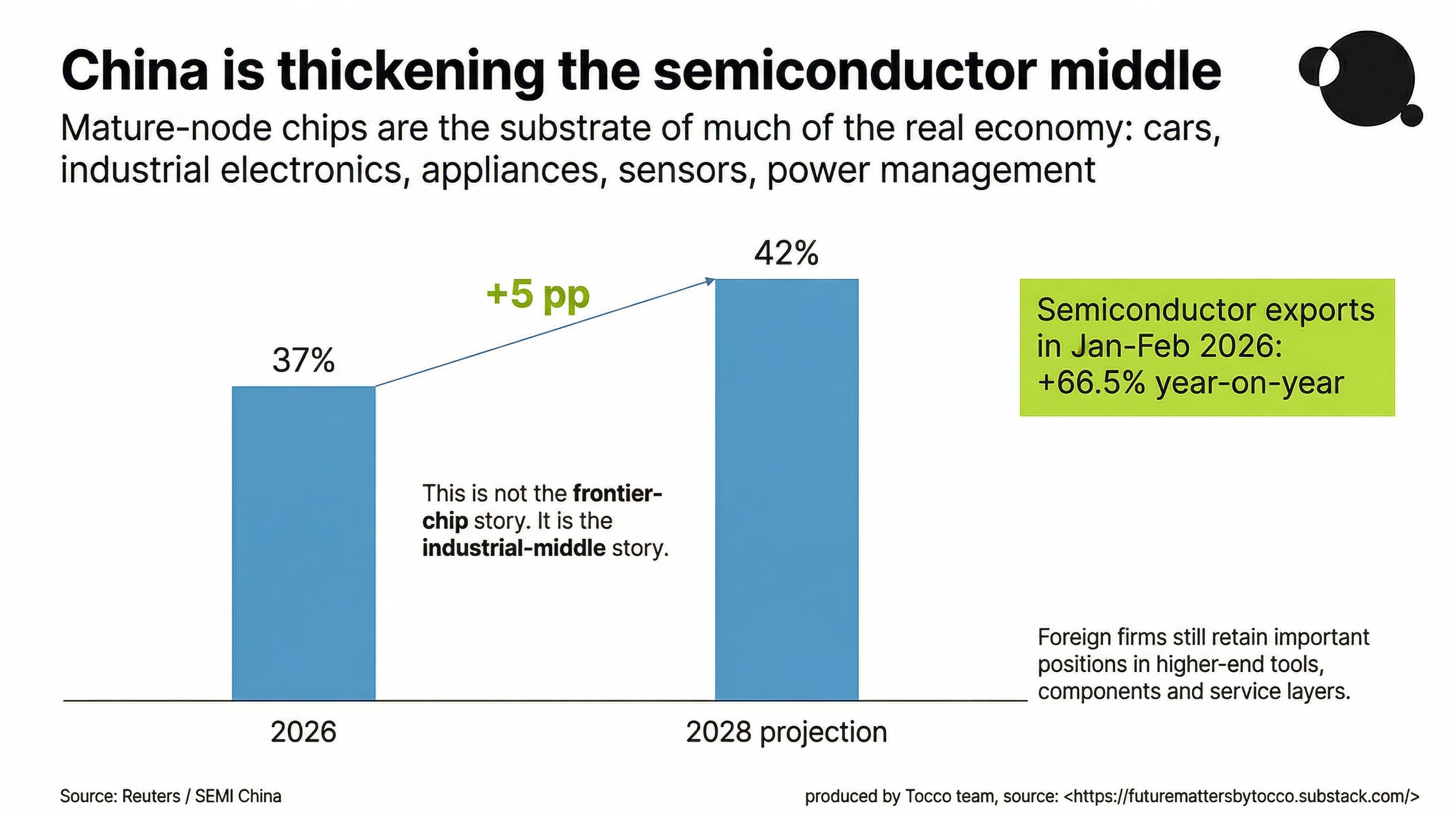
If you only look at the highest end, China still depends heavily on foreign firms for many high-end tools, components, and service layers. But the mature-node story matters enormously too. Chinese manufacturing capacity for 22nm to 40nm chips, used in cars, smartphones, industrial electronics, and a lot of the real economy, is projected to rise from 37% of global output in 2026 to 42% by 2028.
Why is this strategically powerful?
Because much of industrial life still runs on “good enough” chips rather than frontier chips.
Cars. Industrial controls. Appliances. Sensors. Power management. Factory electronics. Connectivity modules. If China keeps thickening capacity in this middle layer while AI demand also pushes growth in testing, packaging, optical interconnects, and specialised materials, then the country is not only advancing in semiconductors. It is reinforcing an entire manufacturing substrate.
There is a trade dimension to this as well.
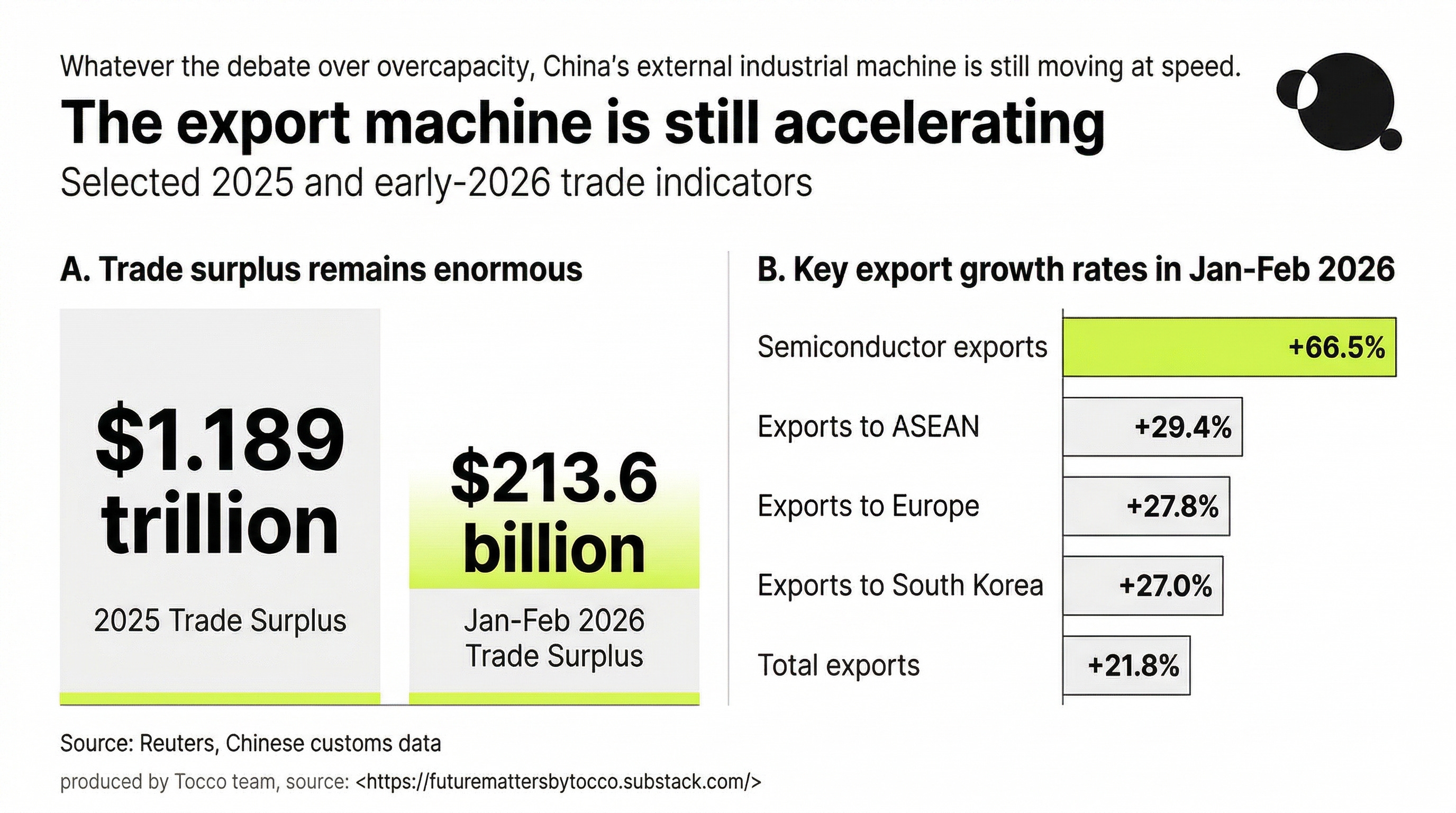
China closed 2025 with a record $1.189 trillion trade surplus. In the first two months of 2026, exports rose 21.8% year-on-year, imports rose 19.8%, and the trade surplus reached $213.6 billion. Semiconductor exports jumped 66.5%. Exports to ASEAN rose 29.4%, while shipments to Europe and South Korea rose 27.8% and 27% respectively.
This is where the document becomes genuinely interesting.
China is trying to do two things at once.
It wants more control over core technologies, more resilience in key supply chains, and more ability to absorb shocks from Washington and beyond.
At the same time, it wants foreign companies, foreign capital, foreign know-how, and foreign market confidence to keep participating in China’s own industrial rise. Beijing is now expanding investment incentives across 200 sectors, especially in advanced manufacturing, green technology, and modern services, while promising equal treatment for foreign and domestic firms.
The two points can sound contradictory at first glance, but it is truly not. China wants more domestic control and more global centrality. More self-reliance and more gravitational pull. More internal resilience and more external dependence on China. In other words, it does not want decoupling. It wants asymmetry managed on better terms. That is a much sharper way to read the plan than the usual tired binary of “opening up” versus “closing down.”
The green transition fits this same logic.
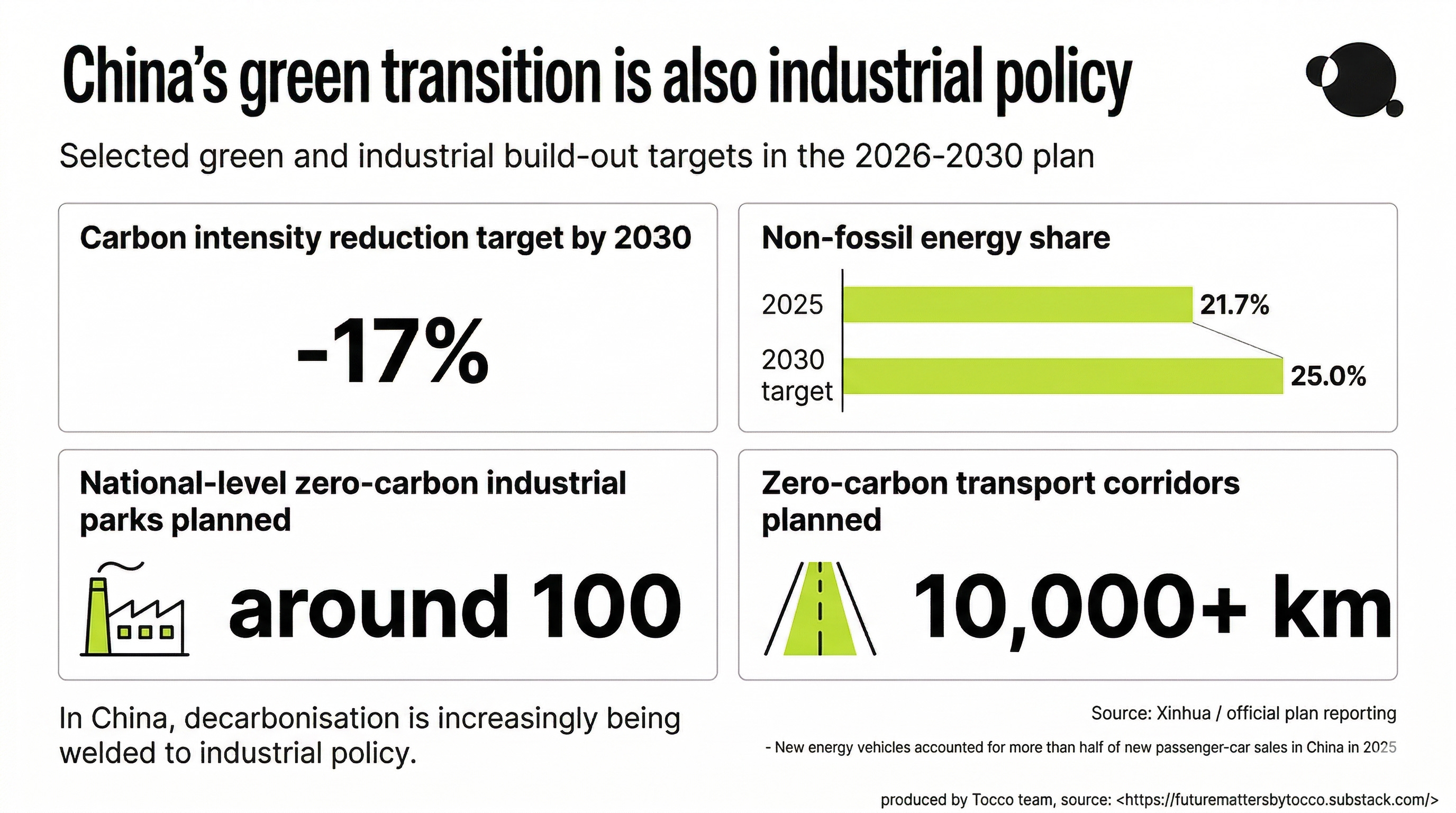
This is another place where outside observers often miss the point. The plan’s green targets are not only environmental but also industrial targets. Xinhua reported that the draft outline includes:
a cumulative 17% reduction in carbon emissions per unit of GDP over the next five years
lifting the share of non-fossil energy in total energy consumption to 25% by 2030 from 21.7% in 2025
building around 100 national-level zero-carbon industrial parks,
and planning more than 10,000 kilometres of zero-carbon transport corridors.
What this implies is: more grid equipment, more storage, more power electronics, more industrial software, more retrofitting, more materials substitution, and more procurement discipline through supply chains.
This is why I keep saying the plan is industrial before it is ideological, as it tells you where equipment demand could deepen, where supplier density could thicken, where price pressure could intensify and where Chinese standards and capabilities could become harder to avoid.
To be clear, none of this means China has solved its own problems.
China is still wrestling with weak domestic demand, property aftershocks, deflationary pressure, and a decline in foreign direct investment. FDI fell 9.5% over the course of 2025 and was down another 5.7% year-on-year in January 2026.
China still has excess capacity in some sectors, real geopolitical exposure, dependence on foreign firms in parts of high-end semiconductors and equipment (as mentioned above), and the recurring risk that political control can crowd out entrepreneurial adaptability.
But that is exactly why serious people should read the plan. China does not need to execute perfectly to become more formidable. It only needs to keep compounding faster than rivals in enough important layers of the industrial stack.
That is the point executives should be paying attention to, especially in a world where Europe is still struggling with energy fragility and industrial drift, and where the United States remains torn between industrial ambition and political volatility.
Leon Ge
March 26 2026
P.S. This is the first in a short series on China’s 2026-2030 plan and what it means for the physical economy. In the next pieces, I’ll go deeper into what this means for materials, machinery, industrial AI - for Europe, the US and China. You can reach me at leon(at)tocco.earth.
Private invitation: FutureMade China
A small group of founders, investors, and senior operators will join us in 2026 for a closed-door immersion into China’s industrial frontier - from advanced manufacturing and robotics to AI, biomanufacturing, and the ecosystems shaping the next decade. If you want to see the China that most executives never get access to, apply for an invitation here.