


Three stories that matter this week:
1/ China and ASEAN just crossed the mark of $1 trillion in trade. Bilateral trade between China and ASEAN surged past $1.05 trillion in 2025, up 7.4% year-on-year, and jumped another 24.7% to $744.41 billion in the first 7 months of 2026. As a matter of fact, China has been ASEAN’s largest trading partner for 17 consecutive years, and ASEAN has held the same title with China for 6 years. This is the result of the “China+1 strategy” as we detailed here.
At the G20 Finance in Asheville starting August 31, US Treasury Secretary Scott Bessent called China’s $1.2T trade surplus a product of “distorted policies that privileged countries’ own exports“. China’s Central Bank Governor pushed back, saying “China never deliberately pursues a trade surplus,“ and separately argued that the US’ $750 billion Inflation Reduction Act subsidies weaken its case against Chinese industrial policy.
As President Trump and President Xi prepare to meet in Washington starting September 23, both sides are working toward a bilateral Board of Trade that would allow up to $30 billion in reduced-tariff trade per side in non-sensitive sectors. Meanwhile, it seems like President Trump is very busy renaming things.
2/ Speaking of the Hormuz Strait, European gas prices spiked above €70 per megawatt-hour as a result of this very Strait’s disruption, leaving Germany the most affected. Storage sat at just 51.5% full as of August 25, compared to 69% a year earlier, and the country is required to hit 70% by November 1.
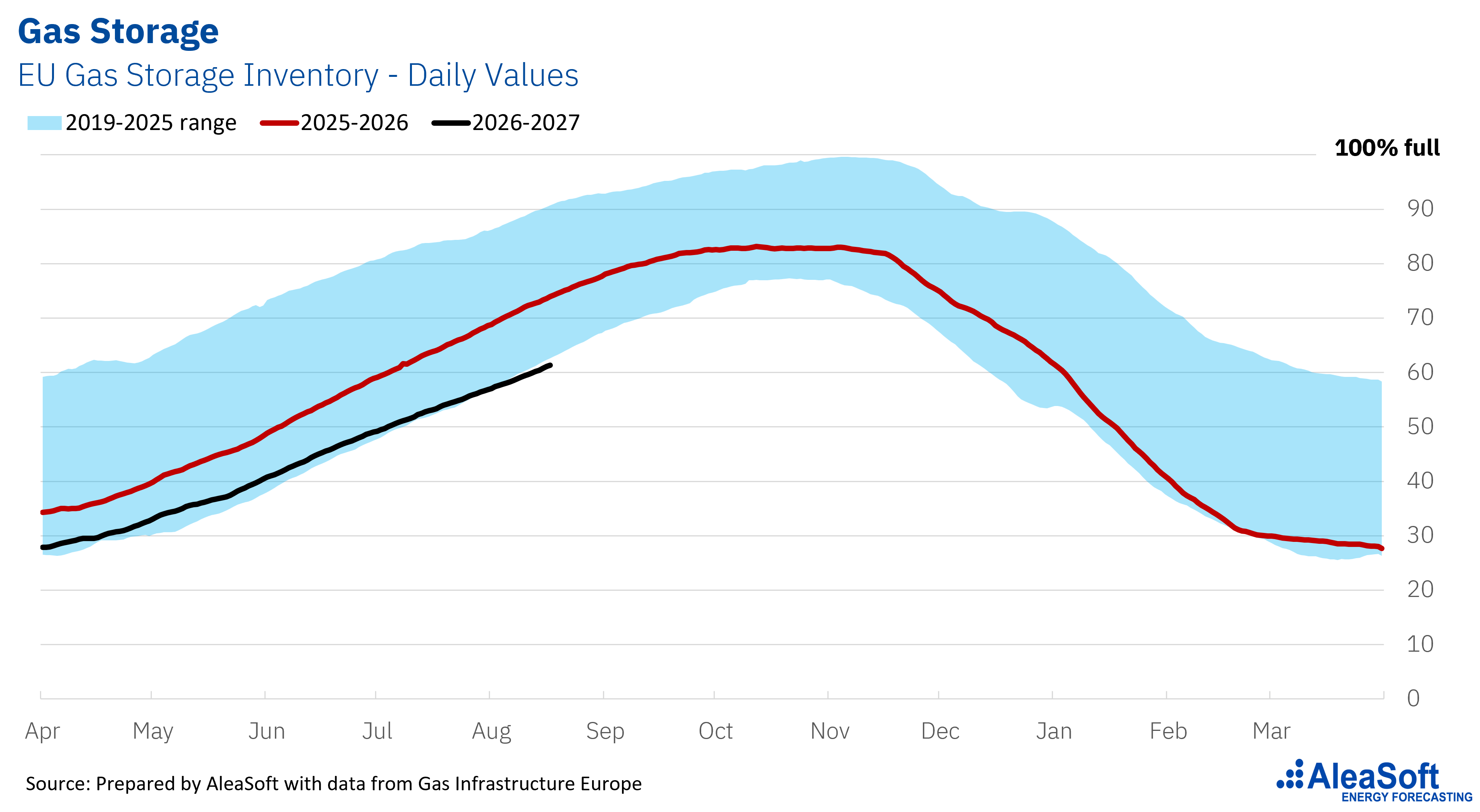
As the gas-storage association INES’s managing director Sebastian Heinermann put it: “If insufficiently filled gas storage facilities coincide with a very cold winter, Germany may no longer be able to cover normal gas demand in full... If gas prices then rise above the level that industrial consumers can afford, companies will be forced to reduce production.”
Germany’s pharmaceutical & mechanical engineering associations have also both flagged the risk, since many industrial gas processes cannot be shut down or switched at short notice. Goldman Sachs analysts estimate that if Gulf exports normalise only gradually through 2027. We’ll keep track of how this would affect European manufacturers during Winter 2026, moving to 2027.
3/ On August 31, Nvidia is increasingly acting as a financial & infrastructure enabler of the AI race. In Texas, Nvidia agreed with Hut 8 to secure capacity at a data center under development in Nueces County and will hold the lease while supplying the facility with chips. That arrangement supports Lambda’s planned $35 billion cloud-computing deal with Anthropic. The agreement follows Anthropic’s roughly $45 billion deal with Nscale for about 460 megawatts of compute capacity at a planned West Virginia data center, expected to use Nvidia’s Vera Rubin chips, reported on August 26.
Beyond data centers, Nvidia’s physical AI division (cars, robots, drones) generates about $10 billion in annual revenue, and CEO Jensen Huang expects it to grow 10x within 10 years, as China’s boom in humanoid robots and industrial robots is projected to continue.
To give you an idea of how huge Nvidia’s business is, here’s a quick math: Fast Retailing, the Japanese parent of Uniqlo, is the world’s 3rd largest apparel retailer by sales, behind Inditex (Zara) and H&M. Its revenue was about $22 billion in FY2025, after growing 9.6% year on year (already remarkable growth). Nvidia, by contrast, reported $96.2 billion in revenue in the last quarter and $215.9 billion for FY2026. This means it would take Fast Retailing about 17 years at today’s revenue level to match what Nvidia is currently running at per year.

We’ll follow more on this race, and especially how it would affect the autonomous robotics sector and supercapacitors in particular.
Enjoy the rest of your week, stay sharp, and keep building.
Anh & Tri
On behalf of the Tocco team
Further Readings · Supply Chain & Manufacturing News · 09.2026
(Global 🌍) The wearable electronics market has surpassed 500 million annual shipments, and the challenge now lies with responsive materials. Our new briefing profiles the top 14 suppliers that let devices sense, conduct, and respond while staying flexible and washable. Read the full breakdown here.
(Global 🌍) The polymer nucleating agents market is projected to surpass $510 million by 2029, driven by demand for faster cycle times and stronger plastics. Adding just 300 ppm of these agents can cut injection moulding times by 14% and significantly boost polymer stiffness. Our new market map profiles top 6 verified suppliers of nucleating agents. Read the curated list here.
(China 🇨🇳) Chinese heavy industry is pivoting hard into B2B livestream sales, generating $3.12 billion in export revenue through factory-floor broadcasts. Over 16,000 industrial enterprises in Hebei province have adopted the format this year, often hiring foreign hosts to demonstrate machinery like grain processors and cold roll-forming equipment live to international buyers. Some manufacturers now report livestreams account for up to 30% of total overseas revenue.
(US 🇺🇸 / South Korea 🇰🇷) SK Hynix broke ground on a $4 billion advanced packaging facility in Indiana, backed by $458 million in CHIPS Act incentives. The West Lafayette plant will package high-bandwidth memory for AI GPUs, with mass production targeted for the 2nd half of 2029. It won’t fabricate the wafers themselves; those still ship from South Korea, but it brings one of the most complex stages of the AI hardware chain onto US soil.
(US 🇺🇸 / Japan 🇯🇵) SoftBank’s SB Energy issued $5.5 billion in warrants to OpenAI to lock it in as anchor tenant ahead of an IPO. Draft filings reveal what’s behind the AI infrastructure boom: SB Energy has zero operational data centres yet claims a $400 billion contracted backlog, built largely on OpenAI leasing 8 GW of unbuilt capacity in Ohio. Nvidia is backstopping the expansion with $3 billion in equity and residual value guarantees.